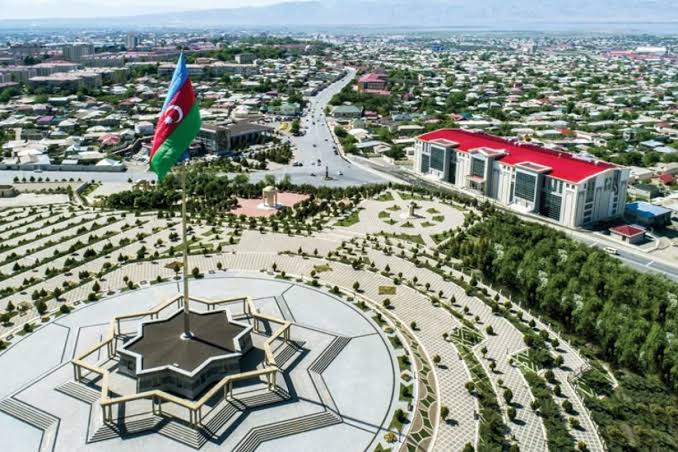
During his visit to Nakhchivan, President Ilham Aliyev gave an interview to Azerbaijan Television. The interview once again highlighted the strategic vision for the future development of the Nakhchivan Autonomous Republic.
The statements made during the interview make it clear that the goals set for Nakhchivan are not limited to socio-economic development. Security, energy, transport, industry, agriculture, tourism, and green energy are being brought together within a unified development concept.
Ensuring Nakhchivan’s security is presented as one of the main pillars of this strategy. The establishment of the Separate Combined Arms Army and its equipping with modern military hardware are cited among the steps taken to strengthen the Autonomous Republic’s defense capabilities.
Energy security is another important component of Nakhchivan’s development strategy. Achieving 100 percent gasification, constructing hydroelectric and solar power plants, and launching the construction of a new 300-megawatt thermal power plant demonstrate the aim of diversifying the region’s energy supply. It has also been stated that Nakhchivan has significant solar energy potential and that new projects will be implemented across an area of more than 600 hectares.
However, one of the most important messages of the interview concerned Nakhchivan’s transport potential. The establishment of the Zangezur Corridor is strategically important not only for restoring Nakhchivan’s land connection with the rest of Azerbaijan, but also for integrating the region into the broader regional transport network.
President Ilham Aliyev stated that the initiative to establish the Zangezur Corridor came from Azerbaijan and that an important decision in this direction was made at the Washington Summit on August 8, 2025. He emphasized that the launch of the TRIPP project had marked a new stage in efforts to implement the corridor.
Excerpt from President Ilham Aliyev's speech:
“Immediately after the Second Karabakh War ended, we began restoring both railway and road infrastructure, including the construction of roads leading towards Nakhchivan. Today, the Horadiz–Aghband highway is almost complete. Only a minor number of issues remain. The construction of the railway is also progressing rapidly. We can accelerate this project at any time. However, since the Armenian section is not yet ready, we do not see a need to do so, because investments should be directed toward addressing more important and urgent issues. In any case, next year the railway will also reach the Armenian border.”
The restoration of the Nakhchivan railway is another important part of this strategy. Plans envisage the reconstruction of the existing railway infrastructure and increasing its initial annual freight capacity from 1.5 million tons to 15 million tons. This could transform Nakhchivan from a transport link connecting it with other parts of Azerbaijan into an important transit hub at the intersection of the East-West and North-South corridors.
Thus, new opportunities are emerging for Nakhchivan to become a regional transport hub in the coming years. The flow of cargo passing through the region is expected to stimulate economic activity, create new jobs, and increase Nakhchivan’s importance as a transit center.
In the energy sector, the objective is not limited to meeting domestic demand. Plans envisage increasing electricity generation by utilizing Nakhchivan’s solar and hydropower potential and expanding opportunities for electricity exports. During the interview, it was noted that solar power generation in Nakhchivan could reach at least 500 megawatts, with the potential to reach 1,000 megawatts. In addition to Türkiye and Iran, the possibility of exporting electricity to Europe in the future was also highlighted.
From this perspective, the Zangezur Corridor is viewed not merely as a transport project but as a multifaceted regional connectivity initiative. Alongside railways and highways, the corridor could also accommodate electricity and fiber-optic lines, as well as other energy infrastructure in the future.
President Ilham Aliyev stated that Nakhchivan is envisaged to develop within a unified development concept alongside Karabakh and Eastern Zangazur. Increasing Nakhchivan’s renewable energy potential as a green energy zone, establishing energy storage systems, and introducing modern management mechanisms are important elements of this concept.
In other words, the goal is to transform Nakhchivan into not merely a developing autonomous republic, but into a regional hub with its security ensured, capable of generating and exporting energy, integrated into international transport corridors, and expanding its industrial and tourism potential.
.png)

EN
