.png)


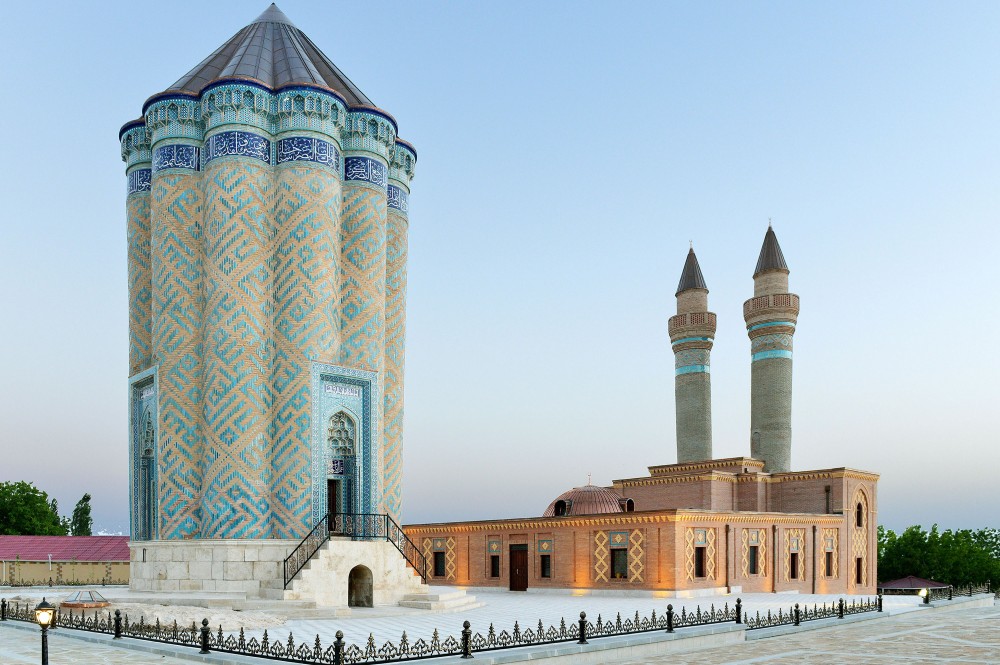
During President Ilham Aliyev’s most recent visit to Nakhchivan, important projects covering industry, energy, transport and logistics, social welfare, urban development, tourism, and the preservation of cultural heritage were presented, while the foundations of several strategic facilities were laid.
Work underway at the “Shams 1” and “Western Horizon” solar power plants, with a combined capacity of 50 MW, is also aimed at strengthening the region’s green energy potential. Once the “Shams 1” plant becomes fully operational, it is expected to generate approximately 57 million kilowatt-hours of electricity annually, equivalent to the amount needed to supply nearly 19,000 households. The project is also expected to prevent approximately 26,000 tons of carbon dioxide emissions and save 12 million cubic meters of natural gas.
The development of Nakhchivan as a “green energy zone” is important not only for strengthening the region’s energy security but also for creating opportunities to export electricity in the future. This direction could enable Nakhchivan to play an important role in the Azerbaijan-Türkiye-Europe energy connection and regional energy transit. In terms of diversifying energy security, the Igdir-Nakhchivan gas pipeline, commissioned in 2025, is also of particular importance. The pipeline contributes to diversifying Nakhchivan’s sources of gas supply and increasing the resilience of its energy system.
The establishment of the Nakhchivan Industrial Park is another important step toward strengthening the region’s production- and processing-oriented economic structure, attracting new investments and modern technologies, transforming local raw materials into higher-value-added products, and increasing exports and employment. The expansion of investment incentives and other state support mechanisms is further increasing entrepreneurs’ interest in the processing industry.
President Ilham Aliyev said the following in an interview with Azerbaijan Television:
“Nakhchivan will engage in electricity exports. The measures being taken to address unemployment, particularly the establishment of the Nakhchivan Industrial Park, will provide a major impetus. The creation of modern industrial complexes in Nakhchivan is envisaged, as is the restoration of social infrastructure. According to the information provided to me, there is a need to build and renovate kindergartens. We will do this. The transport problems of Nakhchivan city have been resolved.”
Transport infrastructure is also one of the key areas for Nakhchivan’s future development. As part of the modernization of the autonomous republic’s 194.2-kilometre railway infrastructure, 10 stations and three passenger platforms are being reconstructed. Following the completion of projects related to the Zangezur Corridor, the annual capacity of the railway line is expected to reach 15 million tons. The opening of the corridor could enable Nakhchivan to become an important logistics hub along the East-West and North-South transport routes. Strengthening railway connectivity between mainland Azerbaijan, Nakhchivan, and Türkiye will create conditions for reducing logistics costs, increasing trade turnover, and generating new business opportunities.
All these projects serve not only Nakhchivan’s socio-economic development but also the further deepening of its integration into the national economy. The measures implemented under the State Program for 2023–2027 provide an important foundation for strengthening the autonomous republic’s position as a center of production, green energy, logistics, trade, and tourism.
Thus, the large-scale projects being implemented in Nakhchivan, together with new state support mechanisms, are laying the foundation for a new stage in the autonomous republic’s development. This new stage is focused on making more effective use of Nakhchivan’s economic potential, developing modern infrastructure, improving the investment and business environment, and enhancing the well-being of its population.