.png)


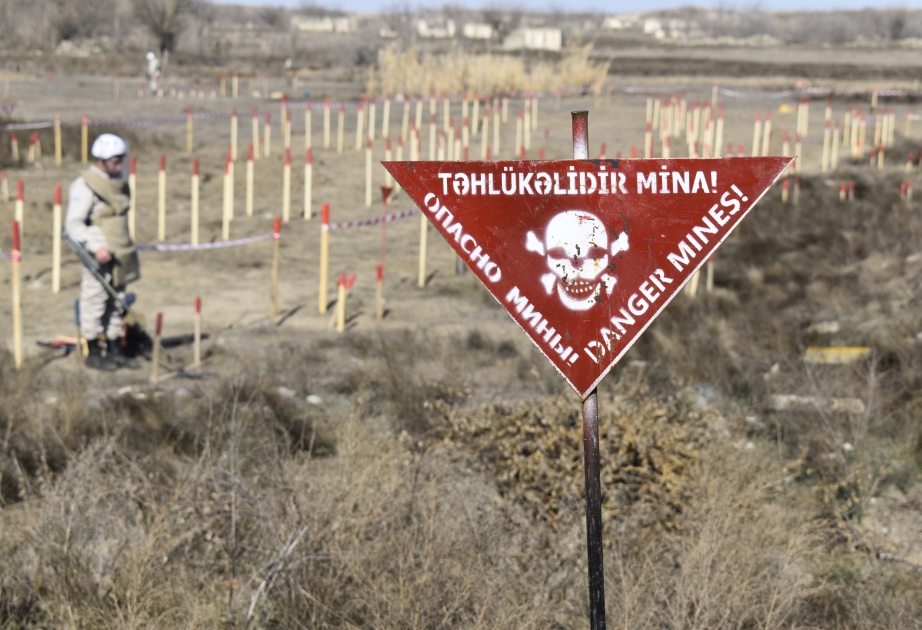
Following the historic Victory achieved in the 44-day Patriotic War and the emergence of new realities in the region, one of the greatest humanitarian and security challenges facing Azerbaijan is the problem of mined territories. More than 1 million mines laid by Armenia on Azerbaijani territory during nearly three decades of occupation continue to pose a serious threat to the lives of civilians, military personnel, and specialists involved in reconstruction efforts. Although the war has ended, mine explosions continue to occur in the liberated territories. Incidents in Kalbajar, Tartar, Aghdam, Fuzuli, Lachin, and other districts have resulted in the deaths and injuries of civilians. The mining of residential areas, agricultural land, cemeteries, water sources, and roads further increases the scale of the threat.
Since 2020, following the end of the Patriotic War, 436 people in Azerbaijan have become victims of landmines. This was reported in a post shared by the Azerbaijani Ministry of Foreign Affairs on its “X” social media account concerning mine explosions. The post drew attention to two mine explosions that occurred in Azerbaijan over the past two days. Two consecutive days. Two mine explosions. Three civilians were injured. These tragic incidents are a painful reminder that the deadly legacy of the conflict continues to endanger human lives, hinder reconstruction efforts, and prevent the safe return of internally displaced persons. It should be recalled that a mine explosion occurred in Khojavand on August 12 and in Kalbajar on August 13. According to official data, more than 1.5 million mines remain in the liberated territories.
President Ilham Aliyev consistently raises the issue of landmines on all international platforms. The head of state regards the mine threat not only as a serious challenge for Azerbaijan but also as a threat to humanity as a whole and to regional stability. Azerbaijan’s key messages include incorporating mine safety into the UN Sustainable Development Goals, highlighting the very low accuracy of the mine maps provided by Armenia—around 25 percent—and Armenia’s refusal to provide accurate maps, as well as increasing international financial and technical assistance to Azerbaijan.
Despite this, Azerbaijan is gradually clearing its territories of mines through its own resources and modern technologies. Accelerating demining operations enables the successful implementation of the Great Return Program, the safe return of former internally displaced persons to their ancestral homes, and the expansion of reconstruction efforts. People are resettled only in areas that have been fully cleared and certified as safe.
Every square meter of land cleared of mines means the construction of a new home, a school, and a safer future. The Great Return is not merely about relocating people to their ancestral lands; it is also about restoring peaceful and safe life in those territories.