.png)


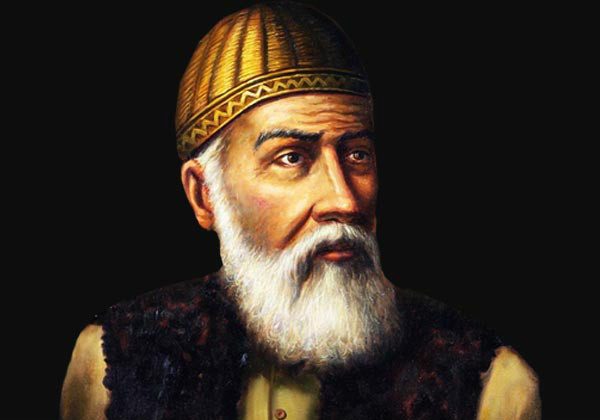
Muhammad Fuzuli was born in 1494 in the city of Karbala, Iraq. Fuzuli belonged to the Turkic Bayat tribe, which was well known in Azerbaijan. According to some sources, his father, Suleyman, had migrated to Iraq from the Arash district of Azerbaijan. Fuzuli received his primary education in Karbala and continued his studies in Baghdad. He also lived for some time in the Iraqi cities of Najaf and Hilla. Through extensive personal reading, he became well acquainted with medieval sciences, particularly religious and philosophical movements, as well as Greek philosophy through Arabic translations. He also studied classical Turkish, Arabic, Persian, and Indian literature.
He is recognized as one of the greatest representatives of the divan tradition in the history of Azerbaijani-Turkic literature. Although Fuzuli dedicated his work Bang u Bade (Opium and Wine) to Shah Ismail Khatai, he did not seek a position at the royal court. He presented several qasidas to the Ottoman Sultan Suleiman the Magnificent. Fuzuli met the Turkish poets Khayali and Yahya Bey, who had traveled to Baghdad with Suleiman’s army. At their request—whom he called the “refined men of Rum”—he wrote his famous poem Leyli and Majnun (1537).
Fuzuli wrote in three languages—Turkish, Arabic, and Persian—and produced ghazals, qasidas, musaddases, tarkib-bands, tarjib-bands, rubais, qit’as, murabbas, and other forms. He wrote exclusively in the aruz meter and created works both in verse and prose, as well as in both lyrical and epic genres. His literary output includes ghazals, qasidas, masnavis, qit’as, rubais, murabbas, mukhammases, tarjib-bands, tarkib-bands, takhmises, and philosophical treatises. He also laid the foundations of artistic prose in the Azerbaijani language.
Fuzuli wrote nearly ninety qasidas and compiled a separate divan consisting of his qasidas. Unlike many of his contemporaries, he praised God rather than rulers in his qasidas. In his qit’as, he raised major social and philosophical questions and expressed his conclusions in artistic language. In this respect, the qit’as in his Turkish divan are particularly distinctive.
His philosophical qasidas and works such as Seven Goblets, Anisul-Qalb (The Consolation of the Heart), and Sihhat va Maraz (Health and Illness) belong to the later period of his life. He collected his qasidas separately and compiled them into a book. In addition, he prepared divans in Turkish, Persian, and Arabic.
The pinnacle of Fuzuli’s literary career, his epic poem Leyli and Majnun, is regarded as one of the rare masterpieces of Azerbaijani, Eastern, and world poetry. Although many Turkish, Persian, Indian, Uzbek, and Tajik poets had addressed the story of Leyli and Majnun, which Nizami Ganjavi had first introduced into written literature, Fuzuli’s version in Azerbaijani Turkic stands apart from earlier works on the subject through its originality.
Written according to all the conventions of the classical masnavi genre, the poem was dedicated to the Ottoman ruler Sultan Suleiman the Magnificent. Unlike Nizami’s version, Fuzuli’s Leyli and Majnun, reflecting the intellectual and spiritual atmosphere of his time, has a stronger Sufi and mystical dimension. The poem also addresses the problem of individual freedom, echoing a theme found in Nizami’s work. It was written at the request of the “refined men of Rum.” Inspired by the motifs of the poem, the great Azerbaijani composer Uzeyir Hajibeyli wrote Leyli and Majnun in 1908, the first opera of the East. A feature film entitled Leyli and Majnun was also made, as was the film Məhəbbət Dastanı (The Epic of Love), based on motifs from the poem.
Fuzuli was familiar with ancient Greek and Eastern philosophy. His philosophical views are reflected primarily in Matla al-I’tiqad, a prose work written in Arabic. In this work, Fuzuli was influenced by the ideas and philosophical heritage of Greek thinkers such as Aristotle, Plato, Empedocles, and Democritus. Philosophical and literary ideas can also be found throughout his other works. Like Nizami, he sought through his writings to influence the social and political course of his time and at times offered advice to rulers and officials.
In his poetry, Fuzuli drew upon all the valuable experience of poets who had written in Azerbaijani Turkic before the 16th century and developed that tradition with great courage and skill. By producing some of the finest examples of lyric poetry, he opened a new, remarkable, and highly influential school in the history of Azerbaijani and Turkic literature. The Fuzuli literary school, with its richness of meaning and content and its artistic excellence, constitutes an artistic encyclopedia of human emotions and thought. This school not only raised the artistic quality of Azerbaijani poetry to an exceptionally high level, but also demonstrated brilliantly the beauty, potential, and power of the Azerbaijani Turkic language. It made an important historical contribution by challenging outdated rules and conventions in classical literature and approaching the traditions of classicism—which hindered development—with courage, freedom, and originality.
Following Nasimi, Fuzuli elevated the literary and artistic language of Azerbaijani through works that represent some of the finest examples of poetry created in the native language. He exerted a powerful influence on classical Azerbaijani literature as well as the poetry of other Turkic peoples and established a literary school of his own. His works have been published numerous times in Tabriz, Baku, Istanbul, Ankara, Cairo, Tashkent, Bukhara, and Ashgabat, and have been highly regarded by scholars of the Orient throughout the world. Muhammad Fuzuli died in Karbala in 963 according to the Islamic lunar calendar, corresponding to 1556 in the Gregorian calendar, from the plague. He was buried there.