.png)


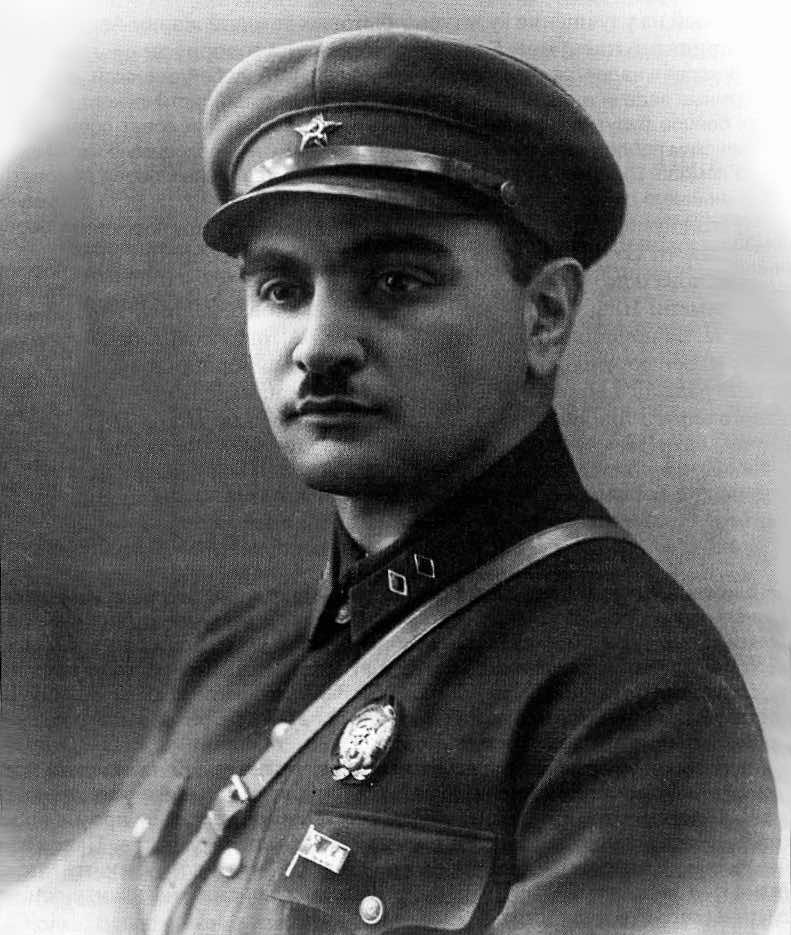
Among the prominent generals in our military history, Jamsid Nakhchivanski, a distinguished representative of the Kangarli dynasty, holds a special place. Jamsid Jafargulu oghlu Nakhchivanski was born on August 9, 1895, in the city of Nakhchivan. An officer of the Army of the Azerbaijan Democratic Republic and a division commander, Jamsid Nakhchivanski successfully continued the military traditions and leadership skills of his ancestors Kalbali Khan, Ismayil Khan, Ehsan Khan, and Huseyn Khan throughout his distinguished career. As a talented military commander, Jamsid Nakhchivanski embarked on an honorable military path and received his education at the Yelizavetgrad Guards School in 1914.
During the First World War, Jamsid Nakhchivanski commanded a cavalry squadron composed of Muslims. He took part in the breakthrough of the “Brusilov Offensive” and was awarded the Order of St. George, 4th Class, for his bravery. Wounded three times on the Austro-Romanian Front, Nakhchivanski was awarded a silver weapon in recognition of his valor as a courageous cavalry officer.
Jamsid Nakhchivanski rendered great service to the military organization of the Azerbaijan Democratic Republic as a prominent military figure. On September 15, 1918, as part of the Caucasus Islamic Army, national military units, and the Separate Corps, he fought resolutely in the liberation of Baku from Armenian-Bolshevik military formations and in the struggle for Azerbaijan’s independence.
It was no coincidence that Jamsid Nakhchivanski, commander of the Second Karabakh Cavalry Regiment, and his soldiers demonstrated true heroism in defeating Armenian armed groups in Karabakh and liberating the Askeran Fortress. Following the Soviet occupation in April 1920, his cavalry regiment was also incorporated into the Red Army. An experienced officer, Jamsid Nakhchivanski was appointed head of the Azerbaijani United Command School established in Baku, and in December 1921, he became commander of Azerbaijan’s first national mountain-rifle division. He played an important role in training highly qualified military personnel. Jamsid Nakhchivanski was awarded the military rank of general on December 5, 1935.
However, in the late 1930s, during a period when the Red Terror was intensifying, Division Commander Jamsid Nakhchivanski became a victim of repression. He spent 97 days enduring severe torture within the walls of the infamous Lefortovo Prison. The verdict was execution by firing squad. Having devoted 26 of his 43 years of life to the art of warfare, the commander was forced to bid farewell to the world at the height of his life and career.
Today, his memory is cherished and he is commemorated with great respect. Even after his death, he continues to inspire the upbringing of heroic young people. His glorious name is honored and introduced to new generations. The specialized military school named after Jamsid Nakhchivanski, established by Heydar Aliyev in 1971, further reinforces this idea. For more than 50 years, the military lyceum has remained an educational institution surrounded by the love and respect of society.
It was precisely through the determination of the National Leader Heydar Aliyev that the unequivocal opposition of the Soviet government to the establishment of this school was overcome through impeccable and unwavering logic, as well as ideological strength. Giving the school the name of Jamsid Khan Nakhchivanski was itself a courageous and historic act. The establishment of this school was not merely a matter of military education; it was a triumph of the belief that Azerbaijan would one day restore its independence and a far-sighted initiative aimed at preparing for that future.