.png)


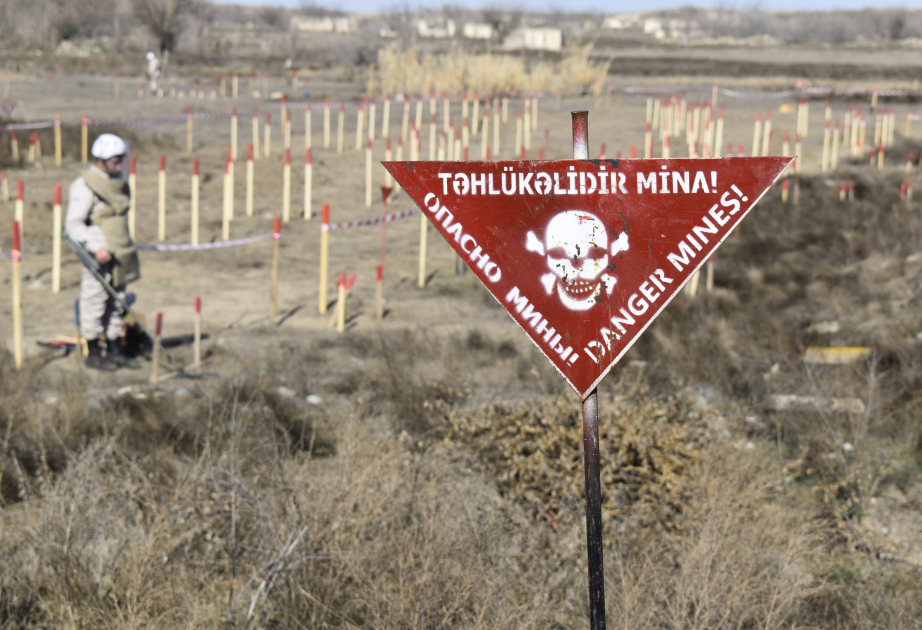
Armenia’s nearly 30-year occupation of Azerbaijan’s territories has left a heavy and long-lasting legacy for our country. The extensive mining of these territories during the occupation remains one of the main challenges facing the reconstruction and development process in the liberated lands today.
According to initial estimates, more than 1 million landmines were planted in these territories. An area of 11,667 square kilometers in the Karabakh and Eastern Zangazur economic regions is considered contaminated with landmines and other explosive remnants of war.
Since 2020, Azerbaijan has been carrying out large-scale efforts to eliminate the landmine threat. Since November 2020, more than 298,000 hectares of land have been cleared of landmines and other explosive devices, while more than 260,000 mines and explosive devices have been detected and neutralized. These figures demonstrate the scale of the resources Azerbaijan has mobilized for the demining process.
However, despite the enormous amount of work carried out, the landmine threat remains a pressing issue. Since the Patriotic War, 437 Azerbaijani citizens have fallen victim to explosive remnants of war. Of them, 73 have lost their lives, while 364 have sustained injuries of varying degrees.
Overall, more than 3,500 Azerbaijani citizens have suffered from landmines as a result of Armenia’s aggression against Azerbaijan. The fact that children and other civilians are among the victims of landmines further highlights the humanitarian scale of the problem.
The inaccurate and incomplete provision of minefield maps by Armenia is also one of the main factors complicating the process. This situation both prolongs demining operations and creates additional risks to the safety of specialists working in the area.
The landmine threat is not merely a danger to human life. It is also a serious obstacle to reconstruction and the expansion of economic activity in the liberated territories, the restoration of transport and communications infrastructure, and, most importantly, the safe return of former internally displaced persons to their ancestral homes.
Nevertheless, the Great Return process continues. Around 40,000 former internally displaced persons have already returned to their homes in the liberated territories, while the number of people living in Karabakh and Eastern Zangazur has exceeded 90,000.
Azerbaijan is using modern technologies, innovative approaches, and advanced management systems to increase the speed and efficiency of demining. At the same time, our country is raising the landmine issue not merely as a national concern but as an international humanitarian problem.
In this regard, the 4th International Mine Action Conference held in Baku last week was of particular importance. Organized jointly by ANAMA and the United Nations Office in Azerbaijan, the event has become an important platform for keeping the landmine threat on the international agenda and expanding the exchange of experience.
The signing of a Memorandum of Understanding between ANAMA and the ASEAN Regional Mine Action Center during the conference also demonstrates that international cooperation in this field has entered a new stage.
Resolving the landmine problem is of strategic importance for the future of Azerbaijan’s liberated territories. Safe territories mean accelerating reconstruction and development, realizing economic potential, and ensuring people’s return to their ancestral lands.
From this perspective, demining is not merely about eliminating a threat; it is also a crucial prerequisite for building Azerbaijan’s safe and sustainable future.